Locations:





Both are healthy choices, but wild-caught salmon offers a few more benefits
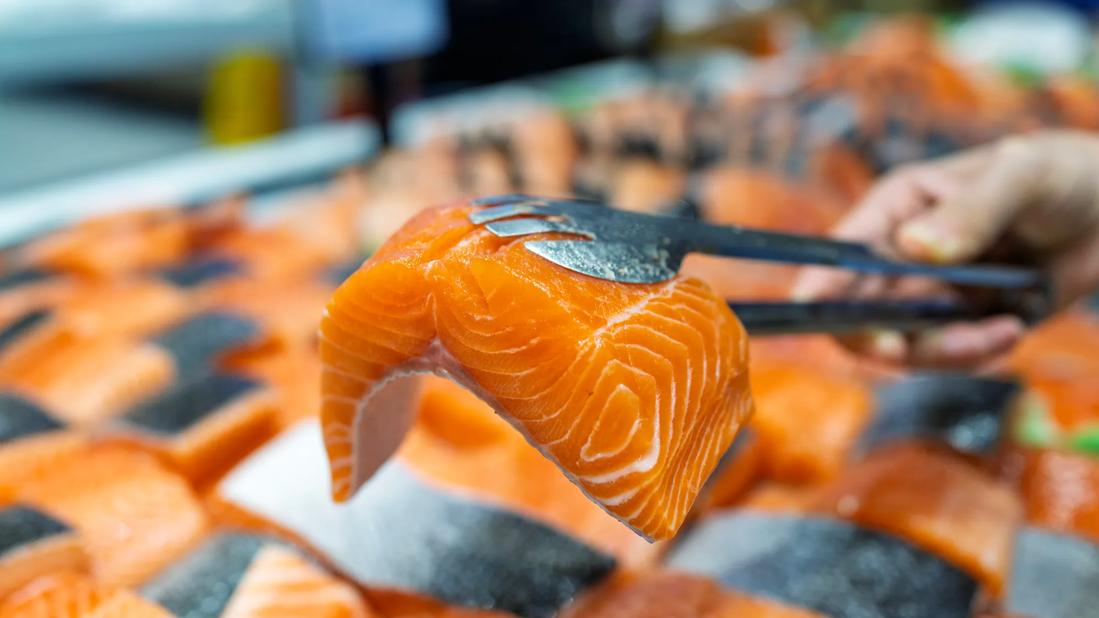
Image content: This image is available to view online.
View image online (https://assets.clevelandclinic.org/transform/ef5a223b-f7c3-48f3-bf76-31d9927a9472/salmon-2273165539)
Person selecting a piece of fresh salmon from a market case
How do you prefer your salmon, wild or from the farm? It’s a legitimate question because not all salmon is equal when it comes to potential health benefits and risks — where it comes from makes a difference.
Advertisement
Cleveland Clinic is a non-profit academic medical center. Advertising on our site helps support our mission. We do not endorse non-Cleveland Clinic products or services. Policy
We asked registered dietitian Julia Zumpano, RD, LD, for a breakdown of wild salmon vs. farmed salmon to see which might be the healthier and more nutritious option.
Let’s go fishing for information to catch the best choice.
Wild-caught salmon is usually one of five types of Pacific salmon — Chinook (king), sockeye, coho, pink and chum. (Sockeye is the most common.) Farm-raised salmon is typically Atlantic salmon.
It’s estimated that about 70% of the salmon eaten worldwide comes from fish farms. Why is that? Well, it comes down to available supply.
The immense popularity of salmon helped deplete the wild stock swimming around in open waters. In response, the salmon aquaculture industry surged as diner demand rose like a high tide.
But while wild and farmed salmon may belong to the same biological family, there are distinct nutritional differences between them, says Zumpano.
The environments they come from — tanks or open waters — also contribute pros and cons.
Here’s a more detailed look at various factors.
Wild salmon is often seen as nutritionally superior to its farm-raised cousin. The reason? Fresh-caught salmon tends to be leaner, lower in calories and richer in certain key vitamins and nutrients.
Advertisement
Chalk it up to lifestyle. As wild salmon spends its life swimming long distances and eating a natural marine diet, its flesh is usually firmer and lower in total fat than that of farmed salmon.
“You get more protein for fewer calories, too,” says Zumpano.
The numbers tell the story. (All data is based on 3-ounce servings of wild sockeye salmon and farmed Atlantic salmon.)
| Wild Salmon | Farmed Salmon | |
|---|---|---|
| Protein | 22.5 grams (g) | 18.8 grams (g) |
| Calories | 133 | 175 |
| Total fat | 4.7 g | 10.5 g |
| Saturated fat | 0.8 g | 2.0 g |
| Omega-3s | 0.8 g | 1.8 g |
| Vitamin B12 | 3.8 micrograms (mcg) | 2.4 micrograms (mcg) |
| Niacin (vitamin B3) | 9 milligrams (mg) | 7 milligrams (mg) |
| Vitamin D | 14 mcg | 11 mcg |
| Phosphorus | 259 mg | 214 mg |
| Potassium | 371 mg | 326 mg |
| Selenium | 30 mcg | 35.2 mcg |
| Protein | ||
| Wild Salmon | ||
| 22.5 grams (g) | ||
| Farmed Salmon | ||
| 18.8 grams (g) | ||
| Calories | ||
| Wild Salmon | ||
| 133 | ||
| Farmed Salmon | ||
| 175 | ||
| Total fat | ||
| Wild Salmon | ||
| 4.7 g | ||
| Farmed Salmon | ||
| 10.5 g | ||
| Saturated fat | ||
| Wild Salmon | ||
| 0.8 g | ||
| Farmed Salmon | ||
| 2.0 g | ||
| Omega-3s | ||
| Wild Salmon | ||
| 0.8 g | ||
| Farmed Salmon | ||
| 1.8 g | ||
| Vitamin B12 | ||
| Wild Salmon | ||
| 3.8 micrograms (mcg) | ||
| Farmed Salmon | ||
| 2.4 micrograms (mcg) | ||
| Niacin (vitamin B3) | ||
| Wild Salmon | ||
| 9 milligrams (mg) | ||
| Farmed Salmon | ||
| 7 milligrams (mg) | ||
| Vitamin D | ||
| Wild Salmon | ||
| 14 mcg | ||
| Farmed Salmon | ||
| 11 mcg | ||
| Phosphorus | ||
| Wild Salmon | ||
| 259 mg | ||
| Farmed Salmon | ||
| 214 mg | ||
| Potassium | ||
| Wild Salmon | ||
| 371 mg | ||
| Farmed Salmon | ||
| 326 mg | ||
| Selenium | ||
| Wild Salmon | ||
| 30 mcg | ||
| Farmed Salmon | ||
| 35.2 mcg |
Now, in the chart above, you may have noticed that farmed salmon has more heart-healthy omega-3 fatty acids. That’s a byproduct of it having more total fat and less-healthy saturated fat, clarifies Zumpano.
So, while wild salmon has a lower amount of omega-3, it offers a better balance of omega-3s related to other fats — making for a healthier total package.
Expect a different dining experience depending on which type of salmon hits your plate.
Wild salmon tends to have a firmer texture and a bold, from-the-sea “fishy” flavor. Farmed salmon is usually softer, given its higher fat content, and a bit milder and buttery in taste.
How the two types of salmon look can be very different, too. Wild salmon is usually a deep red-orange color, with different shades visible in the filet. Farmed salmon typically has a uniform pink or light orange hue created through a pigment in fish feed pellets.
Catching wild salmon comes at a cost — and that’s reflected in the price. Wild-caught salmon tends to be two to three times more expensive than farm-raised salmon.
The different environments wild and farmed fish come from also affect what you’re eating, says Zumpano. Factors include:
For years, farmed salmon tested higher than wild-caught salmon for persistent organic pollutants (POPs) — which are as unhealthy as they sound. The contamination came through feed made from smaller fish with POPs, like dioxins and PCBs (polychlorinated biphenyls).
But changes in feed formulation adopted by many salmon producers have helped significantly lower POPs levels. Studies have even found that some farmed salmon contain less POPs than wild salmon.
Still, POPs levels in farmed salmon can vary depending on where they were raised, cautions Zumpano.
Both wild and farmed salmon are considered low-mercury seafood options by various food safety organizations. It’s considered a “best choice” to limit potential consumption of the toxic metal.
But while both score low, research shows that farmed salmon often has lower levels of mercury. Like with pollutants, though, mercury levels in wild and farmed salmon vary based on where they last swam around.
Advertisement
Tanks at salmon farms don’t leave fish a whole lot of room to roam. Given the tight quarters, an infection that pops up in one fish can easily be shared. Antibiotics are often used to guard against the spread of disease.
Over time, researchers say this can lead to the development of resistant bacterial strains in the overall environment that threaten the health of fish and, eventually, people.
“In the big picture, it is a concern,” notes Zumpano.
When it comes to picking between wild and farmed salmon, there’s no wrong choice, emphasizes Zumpano. Each contains nutrients that make fish a heart-healthy addition to your diet.
“Wild salmon and farmed salmon both bring health benefits to the table. You can’t go wrong with either one,” she says. “But if you have a choice and can afford it, wild salmon is usually the better option.”
Advertisement

Sign up for our Health Essentials emails for expert guidance on nutrition, fitness, sleep, skin care and more.
Learn more about our editorial process.
Advertisement
This East Asian and subtropical fruit is packed with delicious nutrition
Lean meats, fish, dairy and plant proteins can help you meet your protein needs without piling on saturated fat and sugar
This citrus fruit delivers vitamin C, fiber and other nutrients that can support your heart, immune system and skin
Protein is essential in your diet, but piling more onto your plate isn’t always better
Fish packs plenty of protein, heart-healthy fats and other body-boosting nutrients into every bite
This vibrant purple yam offers vitamin C, fiber and antioxidants in every bite
These bright berries are packed with nutrients and antioxidants that may support your eyes, immune system and overall well-being

The general rule is 1.2 to 1.6 grams of protein per kilogram of body weight — but that may not be exactly right for you

Managing your weight through physical activity may lower your chances of getting this common cancer

It typically starts in October and winds down in early spring, with cases at their highest in the middle of winter

Anxiety disorders, health conditions and past trauma can make driving nerve-wracking — help is available
 Search










