Locations:





Attachment theory suggests that your earliest relationships shape connections throughout your life
Decades of research show that your earliest emotional bonds can directly affect the health of your future relationships. It’s called attachment theory, and it’s just one tool we can use to better understand why we behave the way we do with the people we love.
Advertisement
Cleveland Clinic is a non-profit academic medical center. Advertising on our site helps support our mission. We do not endorse non-Cleveland Clinic products or services. Policy
“Your attachment style from your infancy can influence your relationships with others,” says clinical psychologist Coda Derrig, PhD. “But there are a lot of other factors at play, too. We all have multiple experiences that influence our ability to form healthy relationships over time.”
Let’s take a closer look at attachment theory and why it matters.
Attachment theory is a framework that describes the bond between a baby and their primary caregiver — it’s critical for the baby’s survival and lays the foundation for their emotional and social development later on. A secure attachment can mean better adult relationships. Insecure attachments can lead to troubles with future relationships.
“Attachment theory helps us understand the deep link between early caregiving and lifelong emotional health,” Dr. Derrig explains.
Let’s take a look at the history.
British psychoanalyst and psychiatrist John Bowlby first introduced the idea of attachment theory. Dr. Bowlby’s research in the 1950s and 1960s suggested that a child’s relationship with their primary caregiver was of utmost importance for their future development.
Building on that theory, developmental psychologist Mary Ainsworth designed a 1969 experiment called the Strange Situation, which looked at how babies reacted when their mother left a room.
Advertisement
The baby’s reaction to their parent’s departure and return says a lot about how the baby is used to their caregiver attending to their needs, Dr. Derrig notes. And those experiences as youngsters are likely to affect their behaviors as adults.
Based on that study, four attachment styles were identified:
Attachment theory says that the first two years of a baby’s life are the critical time for forming their attachment style.
Secure attachment is the goal, Dr. Derrig notes: “Babies who form secure attachments to their primary caregiver are more likely to become adults who confidently seek out healthy relationships with others and are reliable and loving partners themselves.”
The other three styles are called “insecure attachment styles” and can negatively affect future relationships.
Here’s how the four styles develop.
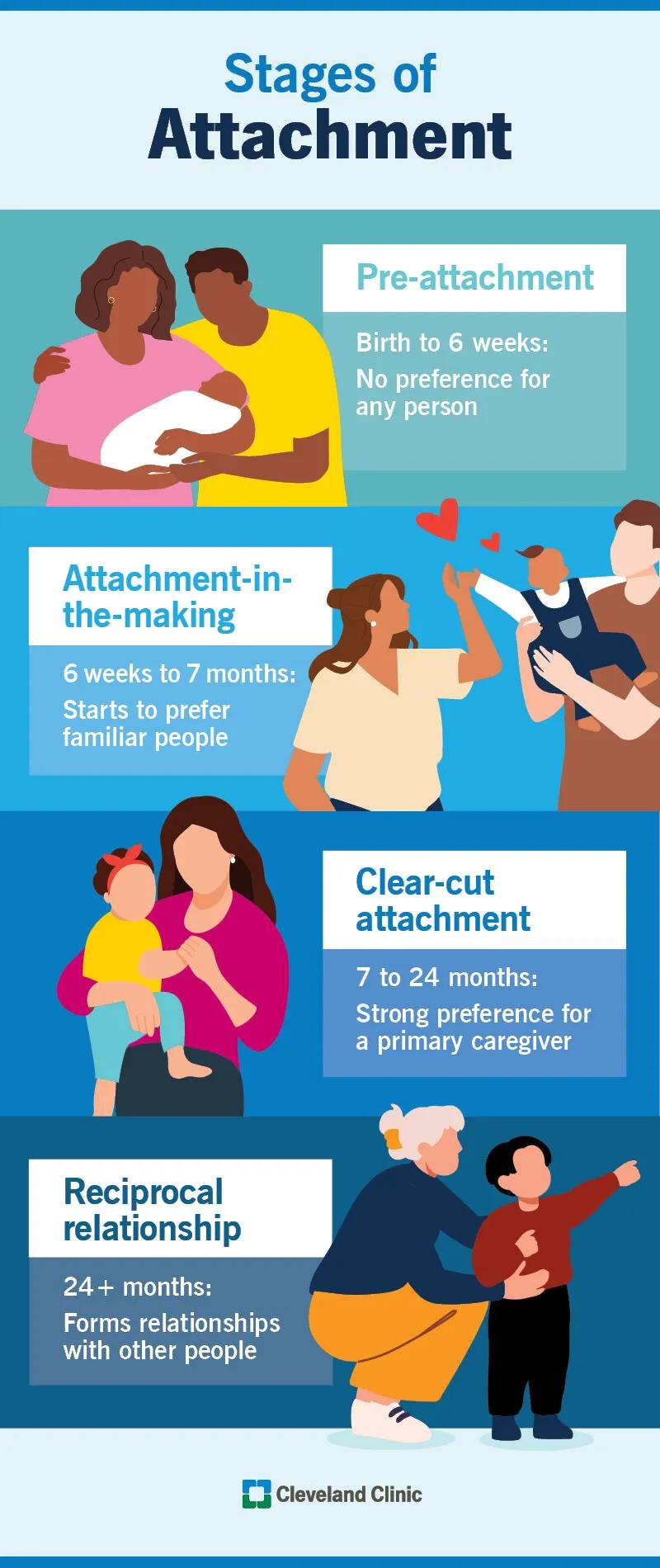
Image content: This image is available to view online.
View image online (https://assets.clevelandclinic.org/transform/e8c49c20-eb83-4491-a389-1a108bfa47e4/attachment-styles-infographic)
Dr. Bowlby suggested that attachment is built in four stages:
Other attachment experts have suggested different phases with other names and slightly different timeframes. But the idea remains the same: The relationships young babies and toddlers develop with their caregivers set the stage for their future development.
Your attachment style — and how it meshes with your partner’s style — can have a hefty impact on your ability to develop healthy and loving relationships and friendships. It can also influence how well you trust others.
Research has shown that attachment styles can affect:
Advertisement
A secure attachment in your toddler years doesn’t guarantee happily ever after. And an insecure attachment doesn’t have to be your destiny either. People — and the relationships they form — are complicated. And your life experiences can change you.
“We aren’t locked into the attachment style we developed in childhood,” Dr. Derrig clarifies. “Although we can’t delete our past experience, the evidence suggests that our attachment styles can — and do — change in response to life events.”
Therapy, healthy adult relationships and life experience can help adults develop an “earned secure” attachment style.
If you’re concerned that your attachment style is affecting your life, talking with a mental health provider can help you understand your experiences and develop new ways of coping in your relationships.
“The more you understand about your attachment style, the more likely you’ll be able to do something about it,” Dr. Derrig says.
Advertisement

Sign up for our Health Essentials emails for expert guidance on nutrition, fitness, sleep, skin care and more.
Learn more about our editorial process.
Advertisement

Someone repeatedly pretending not to know how to do something can create an unhealthy imbalance in your relationship

Counseling can improve communication, rebuild trust and help you work through challenges together

You might be in an unhealthy one if it’s taking up your time, energy and focus

Communicating clear limits helps protect your time, energy and emotional well-being

Being hooked on love can cause unhealthy relationship patterns and obsessive thoughts

When someone guilt trips you, they’re using emotionally manipulative behavior to try to get you to act a certain way

This behavior is usually a sign that the other person doesn’t know how to handle conflict or is prone to being passive-aggressive

It can be harder to let go when you’ve invested time, energy and emotions — but it might be the healthier choice long term

Managing your weight through physical activity may lower your chances of getting this common cancer

It typically starts in October and winds down in early spring, with cases at their highest in the middle of winter

Anxiety disorders, health conditions and past trauma can make driving nerve-wracking — help is available
 Search










