Locations:





 Search
A higher VO2 max allows your body to better convert oxygen to energy to help fuel exercise and strengthen your heart and lungs
If you hang around folks who view cardio exercise as a way of life, you’ve probably heard the term “VO2 max” uttered more than a few times. Many consider the metric the best measure of fitness.
Advertisement
Cleveland Clinic is a non-profit academic medical center. Advertising on our site helps support our mission. We do not endorse non-Cleveland Clinic products or services. Policy
But do you really know what VO2 max tracks? Or what qualifies as a good VO2 max score? We asked sports medicine physician Matthew Kampert, DO, to walk us through it.
VO2 max reflects your body’s potential oxygen uptake, or how much oxygen it can absorb and use while getting pushed to the limit during a workout. To break the meaning down piece by piece:
VO2 max is expressed as a number showing how many milliliters of oxygen your body uses per kilogram of body weight per minute of exercise. (Yeah … it’s a mouthful.) Officially, it is shown as mL/kg/min.
So, why is this data important? Basically, it reveals your body’s power supply potential. That’s because as you breathe in oxygen, it fuels a metabolic reaction within your muscle cells. The process gives your muscles energy called adenosine triphosphate (ATP).
To put it simply: More oxygen pushing through your system equals more energy output.
“Your body needs more energy to work — and it gets that from the oxygen you take in,” explains Dr. Kampert. “Heavier breathing during exercise reflects your body’s increased use of oxygen and production of carbon dioxide, which is let out as you breathe.”
Advertisement
A higher VO2 max means you have:
“VO2 max really gives you an objective view of your overall health,” he adds.
There’s no single number that defines a “good” VO2 max for everyone, given the many factors that affect the measurement.
For starters, studies show that VO2 max tends to naturally decline after age 30, dropping about 5% to 10% per decade. “A ‘good’ VO2 max won’t be the same for you in your 20s as in your 50s,” clarifies Dr. Kampert.
Your sex makes a difference, too, as men average higher VO2 max scores than women at the same age. What’s considered an excellent VO2 max for a 40-year-old man and a 40-year-old woman isn’t the same.
Put it all together, and it means assessing your VO2 max is very personal. So, what actually affects your VO2 max? A few key things:
Still, there are general ranges that reflect how your VO2 max measures up to your peers. The following charts offer a snapshot:
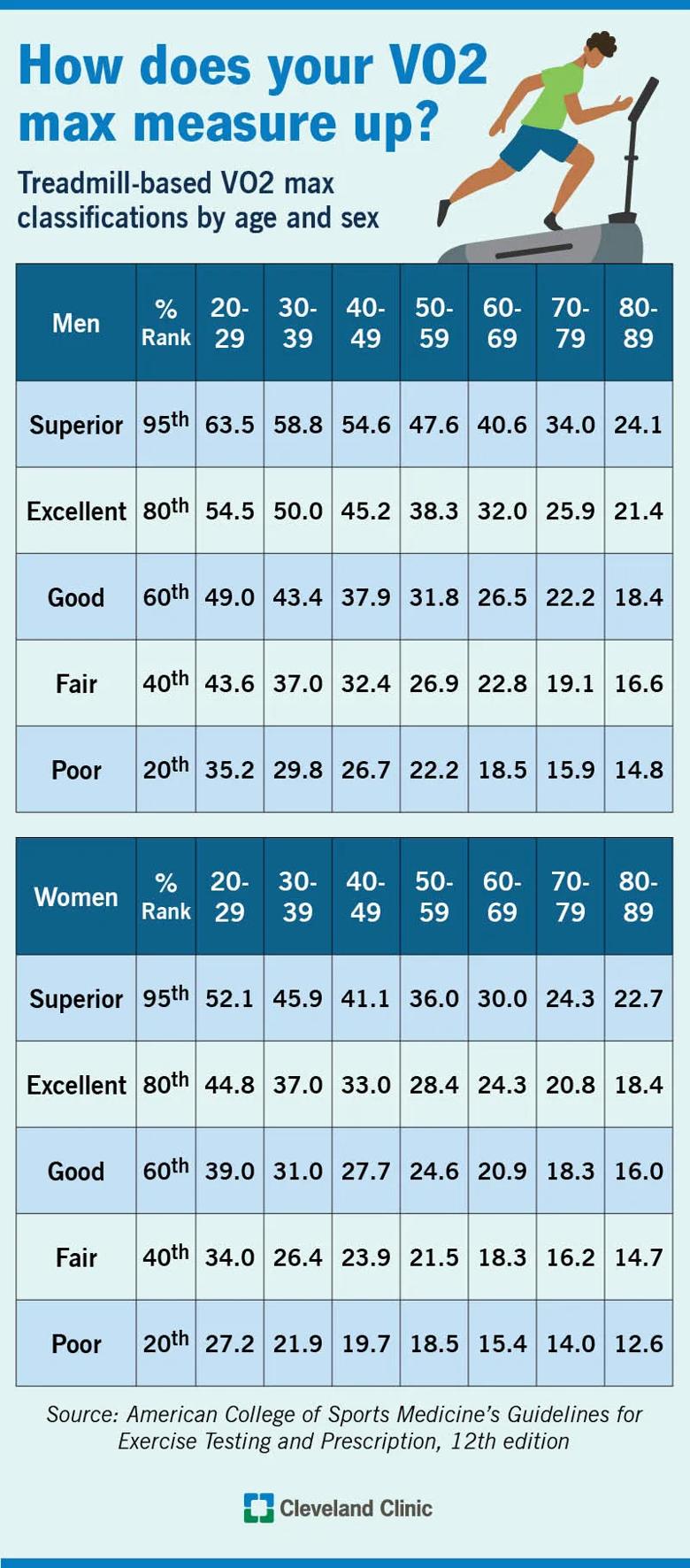
Image content: This image is available to view online.
View image online (https://assets.clevelandclinic.org/transform/760d7d62-0928-4353-9ea2-f3048c64493a/VO2-Max-HowToMeasureImprove-chart-800x1817-r1)
Many fitness trackers and devices estimate your VO2 max by using your heart rate. While those numbers aren’t exact, the results are typically pretty close, according to various studies.
For a more accurate measurement, your best bet is to take a graded exercise test at an exercise medicine lab. Dr. Kampert calls the test the “gold standard” for determining your VO2 max.
Here’s what to expect during the test:
If lab testing isn’t an option, other tests — like shuttle runs, 12-minute runs or cycling protocols — can give you a rough VO2 max estimate. Just keep in mind that they’re not as precise.
Again, your score should be interpreted based on your age, sex and other factors. Small changes in your number (less than 3% to 5%) might just reflect natural test variability. That’s why it’s helpful to repeat the test over time and follow the same protocol each time.
Advertisement
If your VO2 max isn’t where you want it to be, you can improve it. Starting or expanding a workout routine — particularly if it involves more heart-pounding cardio exercise — can boost your numbers.
That would include low-intensity, moderate-intensity and high-intensity activities like:
Losing body fat and building muscle can also raise your VO2 max. The reason why is simple enough: When you lose fat, your body can more efficiently deliver oxygen from your head to your toes.
If you’re just getting started on a workout program, a 10% to 15% improvement in VO2 max is realistic in just a few months. The key is to be consistent and gradually increase the intensity and duration of your workouts.
“Aim for progressive increases rather than absolute targets,” recommends Dr. Kampert.
Exercise should be tailored to your age, fitness level and health. It’s always best to talk with a healthcare provider before starting a program, particularly if you’re older or have existing health conditions.
A mix of high-intensity and moderate-intensity continuous training (MICT) activities often brings the most gains while reducing injury risk. (MICT involves doing a single activity for an extended time, like cycling for 45 minutes.)
Advertisement
Focus on improving your nutrition, sleep and stress, too, as well as recovery after workouts.
“Your VO2 max isn’t set in stone,” says Dr. Kampert. “It can change based on your body and your level of physical activity.”
Your VO2 max offers a good baseline for your fitness and cardiovascular health.
If you’re an athlete in training, your score is a way to see whether your workouts are pushing your body to a higher level for better performance. A higher VO2 max essentially gives you a fuel boost.
As you might expect, professional athletes tend to max out their VO2 max. The highest VO2 max ever recorded belonged to Norwegian cyclist Oskar Svendsen and reached 97.5 ml/kg/min.
Most of us, of course, aren’t on that level, but that doesn’t mean there isn’t value in tracking your VO2 max. Pushing your number higher or even maintaining it as you age can play a huge role in your overall health.
A higher VO2 max can reduce your chance of:
“A high VO2 max across the lifespan is the single most powerful marker of physiological reserve,” says Dr. Kampert. “Develop it early and maintain it consistently and you will measurably increase your years lived in good health.”
Advertisement

Sign up for our Health Essentials emails for expert guidance on nutrition, fitness, sleep, skin care and more.
Learn more about our editorial process.
Advertisement

Breathing techniques may help move your body into a more relaxed and stress-free state

This supercharged oxygen treatment is unregulated and may do more harm than good
Focusing on regulating your breath can help calm your mind
Kettlebells are versatile, space-friendly weights that can help you build strength from head to toe
Start by creating a dedicated space where you can focus on your physical and mental health
By boosting your ‘good’ cholesterol, exercise can indirectly lower your ‘bad’ cholesterol — but it’s most helpful when paired with dietary changes

Beginner’s yoga is all about easing into the practice with foundational poses
Exercising at about 70% of your maximum heart rate can help you burn fat

Simplifying choices, a reassuring attitude and avoiding information overload can help you overcome indecision

Nicotine and other lingering chemicals from smoking can harm people who don’t smoke, including children

The research is mixed, but experts agree: The risks outweigh the benefits











